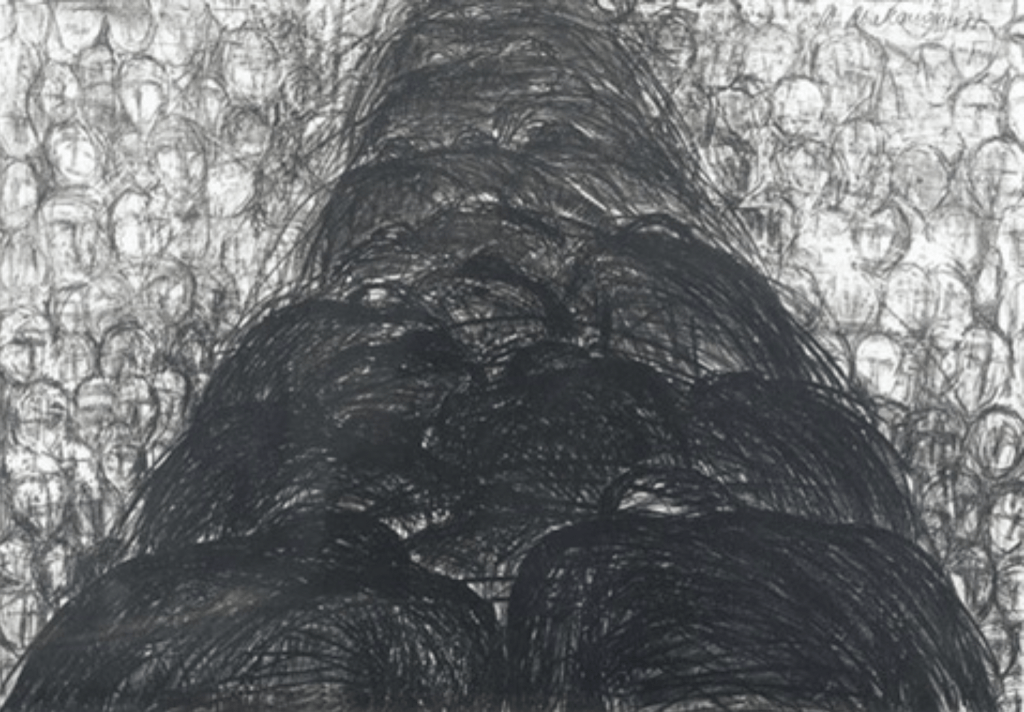
“Die Menge” by Magdalena Abakanovicz
Magdalena Abakanovicz’s lithographic print “Die Menge” presents a striking image: a vast and dark mass, almost indistinguishable as people or individuals, traversing through the center of the composition, starkly demanding the viewer’s attention. Without exception, all in this nameless crowd are depicted with bowed heads and hunched backs, suggesting a burdened and pained demeanor, as if barely able to remain upright. Through skillful use of perspective, Abakanovicz creates the illusion that this throng is moving away from the viewer, dividing the image into two symmetrical halves. In the background, a wall of faces emerges, devoid of perspective, adding a layer of depth to the scene.
Initially, I encountered “Die Menge” with a dismissive eye, mistaking it for student work due to what I perceived as simplistic composition and uninspired use of symmetry. Passing it by without a second thought, I failed to recognize its deeper layers.
Upon encountering the piece again, I experienced a shift in perspective. The name Abakanowicz triggered memories of her sculptures, often laden with imagery of struggle and suffering reminiscent of wartime atrocities. Suddenly, the print took on new significance. The hunched figures seemed to absorb the viewer, evoking a sense of shared burden and pain. In contrast, the crowd in the background, depicted without perspective, appeared detached, their gaze fixed on the viewer in a voyeuristic manner.
As someone born in Denmark, a country that experienced the aftermath of war differently from Poland, Abakanovicz’s work resonates with me on a personal level. The scars of war lingered in my family’s history, manifesting in unresolved conflicts and the silent specter of past traumas. Reflecting on the struggles of Abakanovicz’s homeland, I am reminded of the enduring quest for freedom and the looming specter of oppression.
While some may view Abakanovicz’s work through a purely historical lens, I see it as a poignant commentary on the universal themes of suffering, resilience, and the human capacity for indifference in the face of injustice. As long as nations are invaded, and innocent lives are lost, her message remains relevant and timeless, urging us to confront the consequences of inaction and to strive for a more compassionate world.
 Baagøe Jepsen