Posted in Art Criticism, Curations

Picasso’s Bulls

Picasso’s Bulls as seen at the Gagosian Gallery, London (exhibition curated by Sir John Richardson)

When I visited London some time back, I also had the good fortune to see the Picasso (1881 – 1973) exhibition curated by Sir John Richardson “Minotaurs and Matadors” at the Gagosian Gallery. It’s woth noting that Richardson holds some knowledge on the matter of Picasso, having authored several biographic volumes on Picasso (as displayed for sale at the exhibit) and as longstanding personal friend of Picassso.

Picasso’s Bull Series

Despite having seen many of Picasso’s works exhibited before (an entirely different and much more impressive experience than seeing them in books or online) this once again allowed me a grand experience. Here I saw Picasso’s series of bull drawings, a sequence as if made specifically for use in teaching the process of reduction in art and design. 

While an excellent instrument for teaching, there’s perhaps more to be understood from this series of drawings than a few concepts of design and reduction. Picasso often made it clear that he identified with the bull, making his bull drawings particularly interesting when the choices made in this reductive process is entirely Picasso’s. 

To better understand Picasso, his choices and works, it helps to consider when he was born: In 1881 Brahms was still doing concerts,  Edgar Degas organized and opened the Sixth Impressionists Exhibition in Paris–showing his sculpture “Little Dancer,” Billy the Kid escapes from a New Mexico jail, Sitting Bull surrenders, there was the now famous gunfight at the OK Corral, Thomas Edison and Alexander Graham Bell formed The Oriental Telephone Company (landline telephone,) Barnum & Bailey Circus debuts at Madison Square Gardens—bullfighting was alive and well, even popular and not yet considered offensive. 

In Picasso’s homeland Spain, the bull was a prominent part of their culture and while difficult to imagine today, bullfighting was entertainment. Bullfighting was a part of life and if Le Petit Picador (1889,) painted by Picasso when barely eight years old, can be any indication— bullfighting already made an impression on the young Picasso.

Picasso’s fascination with bullfighting continues and becomes a factor impossible to ignore, right from the blood and gore of bulls and horses of the bullfight, to when the bull meets its end—as dealt by the matador. 

Returning to Picasso, metaphorically identifying with and relating to the bull or better yet–the minotaur as half man, half bull said “If all the ways I have been along were marked on a map and joined up with a line, it might represent a Minotaur.” In Picasso’s world, the bull portion of the minotaur was ultimately destined to fight for its life and die fighting–while the man portion of that same minotaur still tries to make sense of it all. 

Bullfight Symbolism

It could seem that every element of the bullfight held metaphors for Picasso, perhaps helping him to see his person in a more objective light—as the bull with all its gesturing, charging, huffing and puffing rarely wins but always fights a fight worthy of respect. 

With all the cheering and commotion at a bullfight, Picasso would sit quietly through it all—as he identified with the bull, perhaps all too aware of its impending fate. For the bull it’s a fight for life and death, for the matador it’s for show and for the audience, entertainment, even with all its grotesque gore—and Picasso is the bull in his very own bullfight, to give the performance of his life and to personally pay the ultimate price. Even the horses often sacrificed in a bullfight takes on meaning, as Picasso himself sees them as a metaphor for the woman that became victims of his choices and life. 

In his bull series, Picasso takes on his usual role as the artist to expertly select which elements of the bull to include or exclude, and where to draw the focus of the audience. As the number of drawings increase a progression begins to show, as detail gives way to form and design–all with the intentions of finding those essential elements of art in the subject. Picasso’s search for form and design, dissecting this subject (a bull, likened to himself) to find the art, is at this point not so different from a philosopher’s search for truth in the essence of a concept.

While the process involves an obvious reduction of elements, what’s barely noticeable at first is the price of this reduction—as the process nears the end. Intentionally or subconsciously, it becomes more apparent that art has a price.

 As is frequently seen in design and icons, the bulls head is often used to symbolize unstoppable strength, mind, mentality and tenacity—clearly identifying the idea of a bull. 

Picasso’s Personal Reflection

For Picasso, the symbolism of a bull’s mask was enough to suggest himself a bull when wearing it. While the later reduction in size of the bull’s head could be seen as a coincidence if a singular rendition, this was rather a gradual, consistent and therefore deliberate change. For Picasso, having associated himself with the bull and particularly the bull’s head, it would seem a fair guess that he saw his mindset to be like of a bull’s. The later reductions of the bull’s head in Picasso’s renderings would likely suggest that he experienced a gradual reduction of capacity and motivation, perhaps as brought on by age but here to the point of nearly being completely gone.

As can be concluded when viewing the Charging Bull of Wall Street sculpture other parts of the bull also has great significance. The genitals of bulls are often used to refer to the character and traits inherent to the masculinity and strength in a bull, just like people in some parts of the world compare themselves or parts of themselves to that of a bull. 

Surprisingly, in a final stage of reduction—as if to make the biggest statement yet in the last drawing, Picasso almost completely castrates the bull by now drawing the genitals so small as if no longer of any significance or use.

The drawings are indisputably Picasso’s recorded expression as he chose every step of the way, which brings me to question if this was a statement on more than elements of design and abstraction, intentionally or unintentionally? Was this a commentary on art in general, the art world, or was it personal reflection, a visual autobiography (Picasso was never a man of many words?) Did Picasso perhaps feel burdened and/or drained from his own success, as he inescapably became a greater celebrity, seeing his identity, real strength and artistic freedom reduced to the point of being almost removed?

Posted in Art Criticism, Female Figure

Admiring Clésinger

Admiring Clésinger: A Critique and Reflection on “Woman Bitten by a Serpent.”

“Woman Bitten by a Serpent” by Auguste Clésinger (1814–1883), now in the Musée d’Orsay in Paris.

Auguste Clésinger’s “Woman Bitten by a Serpent” stands as a testament to his mastery of form and emotion, capturing a moment of intense beauty and suffering with unparalleled skill. This sculpture, completed in 1847, continues to inspire artists and art lovers alike, including myself, who find in it a perpetual source of inspiration and a benchmark of artistic excellence.

The success of “Woman Bitten by a Serpent” lies in its remarkable attention to detail and Clésinger’s adept handling of the female form. The piece presents a woman in a reclining position, her body twisted in the throes of pain as a serpent bites her. The use of contrapposto, though not novel, is executed with such finesse that it brings a dynamic tension to the composition. The subtle shift of weight and the naturalistic portrayal of the body’s curves and musculature demonstrate Clésinger’s deep understanding of anatomy and his ability to render it with lifelike precision.

“Woman Bitten by a Serpent” by Auguste Clésinger (1814–1883).

One of the most striking aspects of this sculpture is the texture of the skin. Clésinger’s technique creates a palpable sense of flesh, soft and yielding, contrasting sharply with the hard, cold marble. This tactile realism heightens the viewer’s emotional response, drawing them into the woman’s agony and despair. The delicate rendering of the face, with its contorted expression, further emphasizes the intensity of the scene, making it almost unbearably poignant.

“Woman Bitten by a Serpent” by Auguste Clésinger.

Clésinger’s composition also excels in its use of space and movement. The serpentine form of the woman’s body leads the eye in a graceful yet tumultuous journey across the sculpture, from the outstretched arm to the tension in her legs. This movement is both fluid and fraught, encapsulating the dual themes of beauty and suffering. The interplay of light and shadow across the marble surface adds depth and dimension, enhancing the overall impact of the piece.

The serpent in “Woman Bitten by a Serpent” by Auguste Clésinger.

In the context of 1847, female nudity in art had to be justified to align with the moral sensibilities of the time. Artists often depicted nudes as victims of harm or captivity, not to emphasize their suffering but to rationalize their exposed form. Clésinger was acutely aware of these societal constraints, yet his subtle rebellion is evident in the portrayal of the serpent. Instead of presenting it as a menacing creature, he diminishes its threat, rendering it small and almost ornamental—akin to a piece of jewelry. This audacious choice can be seen as Clésinger’s critique of the era’s conventions, mocking the superficial need to validate the presence of nudity with a flimsy pretext of distress.

As an artist, I am continually drawn to the emotional and technical prowess displayed in “Woman Bitten by a Serpent.” Clésinger’s ability to convey such profound emotion through stone is a continual source of inspiration in my own work. His genius in capturing the essence of the female form and the rawness of human experience encourages me to strive for greater emotional depth and anatomical accuracy in my creations. Each study of this piece reveals new insights into the power of form and expression, reminding me of the heights that can be achieved through dedication and skill.

“Woman Bitten by a Serpent” by Auguste Clésinger .

In my practice, I often reflect on Clésinger’s work, seeking to emulate the delicate balance of beauty and turmoil he so masterfully achieves. The way he merges technical precision with emotional resonance serves as a guiding light, pushing me to explore the limits of my abilities and to convey more effectively the subtleties of human experience in my sculptures.

In conclusion, Auguste Clésinger’s “Woman Bitten by a Serpent” is not only a masterpiece of 19th-century sculpture but also a timeless source of inspiration. Its successful elements—contrapposto, texture, movement, and emotional depth—combine to create a work that continues to captivate and influence. For me, it remains a continual ideal, a reminder of the power of art to transcend the material and touch the soul.

Posted in Art Criticism

A Conscience of Civilization


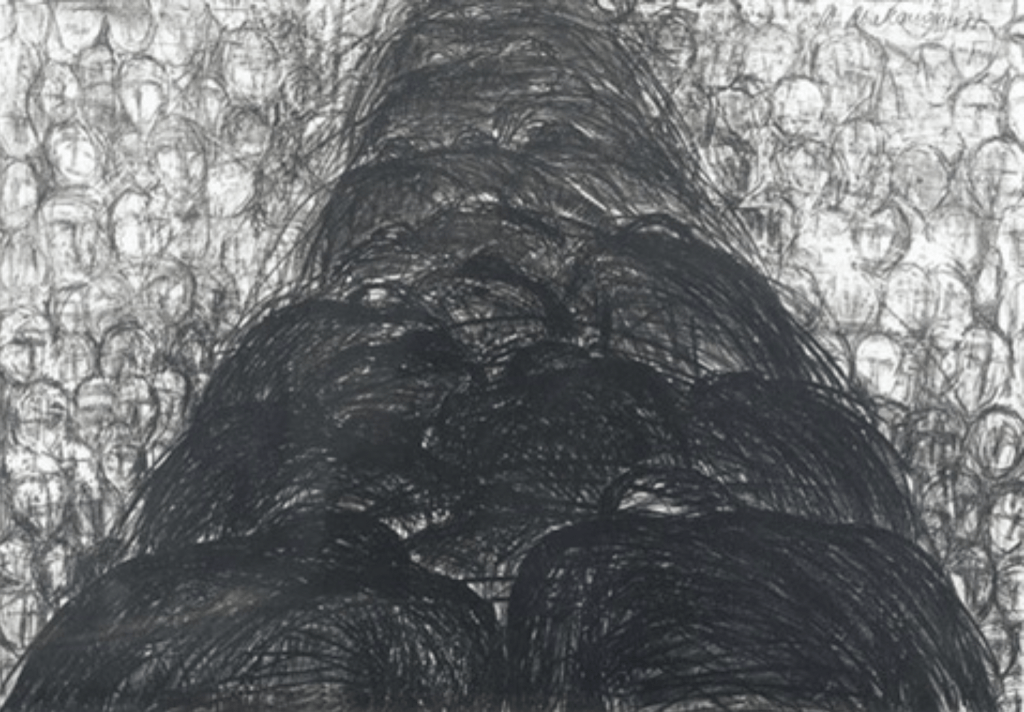
“Die Menge” by Magdalena Abakanovicz

Magdalena Abakanovicz’s lithographic print “Die Menge” presents a striking image: a vast and dark mass, almost indistinguishable as people or individuals, traversing through the center of the composition, starkly demanding the viewer’s attention. Without exception, all in this nameless crowd are depicted with bowed heads and hunched backs, suggesting a burdened and pained demeanor, as if barely able to remain upright. Through skillful use of perspective, Abakanovicz creates the illusion that this throng is moving away from the viewer, dividing the image into two symmetrical halves. In the background, a wall of faces emerges, devoid of perspective, adding a layer of depth to the scene.

Initially, I encountered “Die Menge” with a dismissive eye, mistaking it for student work due to what I perceived as simplistic composition and uninspired use of symmetry. Passing it by without a second thought, I failed to recognize its deeper layers.

Upon encountering the piece again, I experienced a shift in perspective. The name Abakanowicz triggered memories of her sculptures, often laden with imagery of struggle and suffering reminiscent of wartime atrocities. Suddenly, the print took on new significance. The hunched figures seemed to absorb the viewer, evoking a sense of shared burden and pain. In contrast, the crowd in the background, depicted without perspective, appeared detached, their gaze fixed on the viewer in a voyeuristic manner.

As someone born in Denmark, a country that experienced the aftermath of war differently from Poland, Abakanovicz’s work resonates with me on a personal level. The scars of war lingered in my family’s history, manifesting in unresolved conflicts and the silent specter of past traumas. Reflecting on the struggles of Abakanovicz’s homeland, I am reminded of the enduring quest for freedom and the looming specter of oppression.

While some may view Abakanovicz’s work through a purely historical lens, I see it as a poignant commentary on the universal themes of suffering, resilience, and the human capacity for indifference in the face of injustice. As long as nations are invaded, and innocent lives are lost, her message remains relevant and timeless, urging us to confront the consequences of inaction and to strive for a more compassionate world.