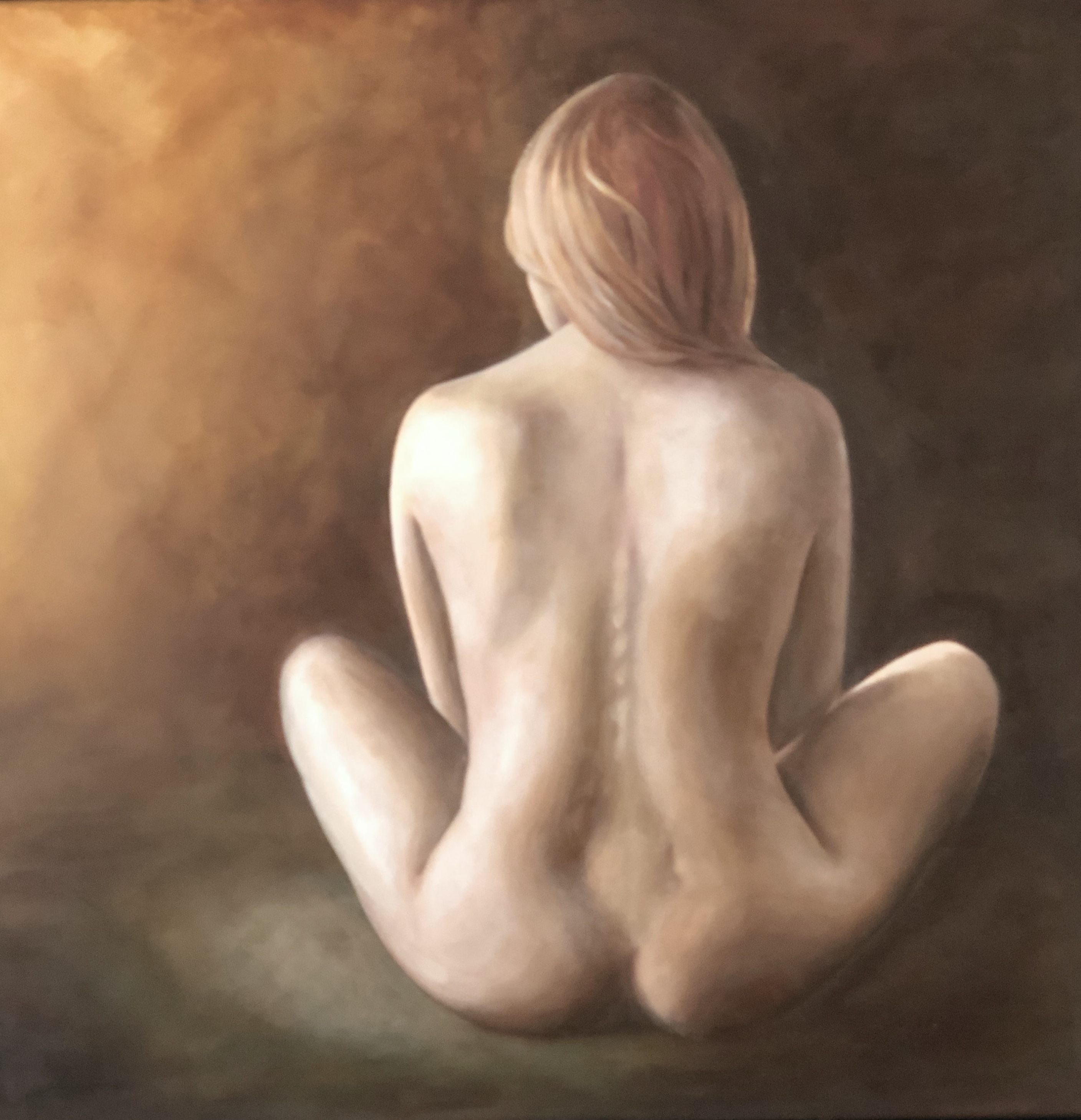
By seeking a more universal representation of the figure and excluding all but the actual torso, I hoped to give credit to the sculptural qualities of the female form and not let the aesthetics be an obstacle to the feelings of the piece.
The emotive qualities were however my top priority. Although perhaps entirely too ambitious, I was looking to depict the inner solace found at the core of total acceptance–not just by others but also oneself.
The cooler tones dominating the piece while the composition eliminates all but a faceless torso, is to make viewing it a less personal and more universal experience, creating a comfortable distance for the viewer to enter the space, and relate.
Auguste Clésinger’s “Woman Bitten by a Serpent” stands as a testament to his mastery of form and emotion, capturing a moment of intense beauty and suffering with unparalleled skill. This sculpture, completed in 1847, continues to inspire artists and art lovers alike, including myself, who find in it a perpetual source of inspiration and a benchmark of artistic excellence.
The success of “Woman Bitten by a Serpent” lies in its remarkable attention to detail and Clésinger’s adept handling of the female form. The piece presents a woman in a reclining position, her body twisted in the throes of pain as a serpent bites her. The use of contrapposto, though not novel, is executed with such finesse that it brings a dynamic tension to the composition. The subtle shift of weight and the naturalistic portrayal of the body’s curves and musculature demonstrate Clésinger’s deep understanding of anatomy and his ability to render it with lifelike precision.
One of the most striking aspects of this sculpture is the texture of the skin. Clésinger’s technique creates a palpable sense of flesh, soft and yielding, contrasting sharply with the hard, cold marble. This tactile realism heightens the viewer’s emotional response, drawing them into the woman’s agony and despair. The delicate rendering of the face, with its contorted expression, further emphasizes the intensity of the scene, making it almost unbearably poignant.
Clésinger’s composition also excels in its use of space and movement. The serpentine form of the woman’s body leads the eye in a graceful yet tumultuous journey across the sculpture, from the outstretched arm to the tension in her legs. This movement is both fluid and fraught, encapsulating the dual themes of beauty and suffering. The interplay of light and shadow across the marble surface adds depth and dimension, enhancing the overall impact of the piece.
In the context of 1847, female nudity in art had to be justified to align with the moral sensibilities of the time. Artists often depicted nudes as victims of harm or captivity, not to emphasize their suffering but to rationalize their exposed form. Clésinger was acutely aware of these societal constraints, yet his subtle rebellion is evident in the portrayal of the serpent. Instead of presenting it as a menacing creature, he diminishes its threat, rendering it small and almost ornamental—akin to a piece of jewelry. This audacious choice can be seen as Clésinger’s critique of the era’s conventions, mocking the superficial need to validate the presence of nudity with a flimsy pretext of distress.
As an artist, I am continually drawn to the emotional and technical prowess displayed in “Woman Bitten by a Serpent.” Clésinger’s ability to convey such profound emotion through stone is a continual source of inspiration in my own work. His genius in capturing the essence of the female form and the rawness of human experience encourages me to strive for greater emotional depth and anatomical accuracy in my creations. Each study of this piece reveals new insights into the power of form and expression, reminding me of the heights that can be achieved through dedication and skill.
In my practice, I often reflect on Clésinger’s work, seeking to emulate the delicate balance of beauty and turmoil he so masterfully achieves. The way he merges technical precision with emotional resonance serves as a guiding light, pushing me to explore the limits of my abilities and to convey more effectively the subtleties of human experience in my sculptures.
In conclusion, Auguste Clésinger’s “Woman Bitten by a Serpent” is not only a masterpiece of 19th-century sculpture but also a timeless source of inspiration. Its successful elements—contrapposto, texture, movement, and emotional depth—combine to create a work that continues to captivate and influence. For me, it remains a continual ideal, a reminder of the power of art to transcend the material and touch the soul.
Whether in trembling fear of what’s to come, relieved with an outcome or elated over the unexpected triumph—the sadness, relief, gratitude, or perhaps even a sense of newfound purpose—can be overwhelming.In honest reflection and its accompanying turmoil, reality is unavoidable—bringing new clarity, allowing the mind to calmly race through memories and reflections, searching for meaning and understanding, maybe questioning your very direction in life.
Yet there’s solace in the quietness. Embracing this stillness opens our soul to the experience of life—bringing the peace needed to heal and find inspiration in letting mind and heart speak to us. Truly listening to our inner resources will reveal the strengths needed to get through life’s many challenges.
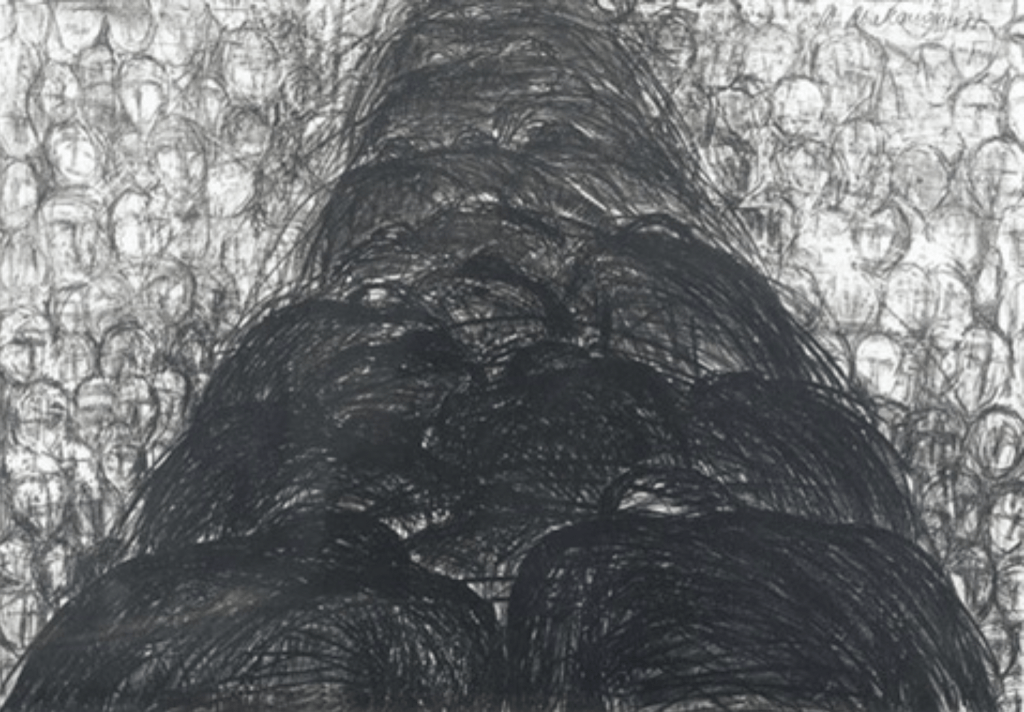
Magdalena Abakanovicz’s lithographic print “Die Menge” presents a striking image: a vast and dark mass, almost indistinguishable as people or individuals, traversing through the center of the composition, starkly demanding the viewer’s attention. Without exception, all in this nameless crowd are depicted with bowed heads and hunched backs, suggesting a burdened and pained demeanor, as if barely able to remain upright. Through skillful use of perspective, Abakanovicz creates the illusion that this throng is moving away from the viewer, dividing the image into two symmetrical halves. In the background, a wall of faces emerges, devoid of perspective, adding a layer of depth to the scene.
Initially, I encountered “Die Menge” with a dismissive eye, mistaking it for student work due to what I perceived as simplistic composition and uninspired use of symmetry. Passing it by without a second thought, I failed to recognize its deeper layers.
Upon encountering the piece again, I experienced a shift in perspective. The name Abakanowicz triggered memories of her sculptures, often laden with imagery of struggle and suffering reminiscent of wartime atrocities. Suddenly, the print took on new significance. The hunched figures seemed to absorb the viewer, evoking a sense of shared burden and pain. In contrast, the crowd in the background, depicted without perspective, appeared detached, their gaze fixed on the viewer in a voyeuristic manner.
As someone born in Denmark, a country that experienced the aftermath of war differently from Poland, Abakanovicz’s work resonates with me on a personal level. The scars of war lingered in my family’s history, manifesting in unresolved conflicts and the silent specter of past traumas. Reflecting on the struggles of Abakanovicz’s homeland, I am reminded of the enduring quest for freedom and the looming specter of oppression.
While some may view Abakanovicz’s work through a purely historical lens, I see it as a poignant commentary on the universal themes of suffering, resilience, and the human capacity for indifference in the face of injustice. As long as nations are invaded, and innocent lives are lost, her message remains relevant and timeless, urging us to confront the consequences of inaction and to strive for a more compassionate world.
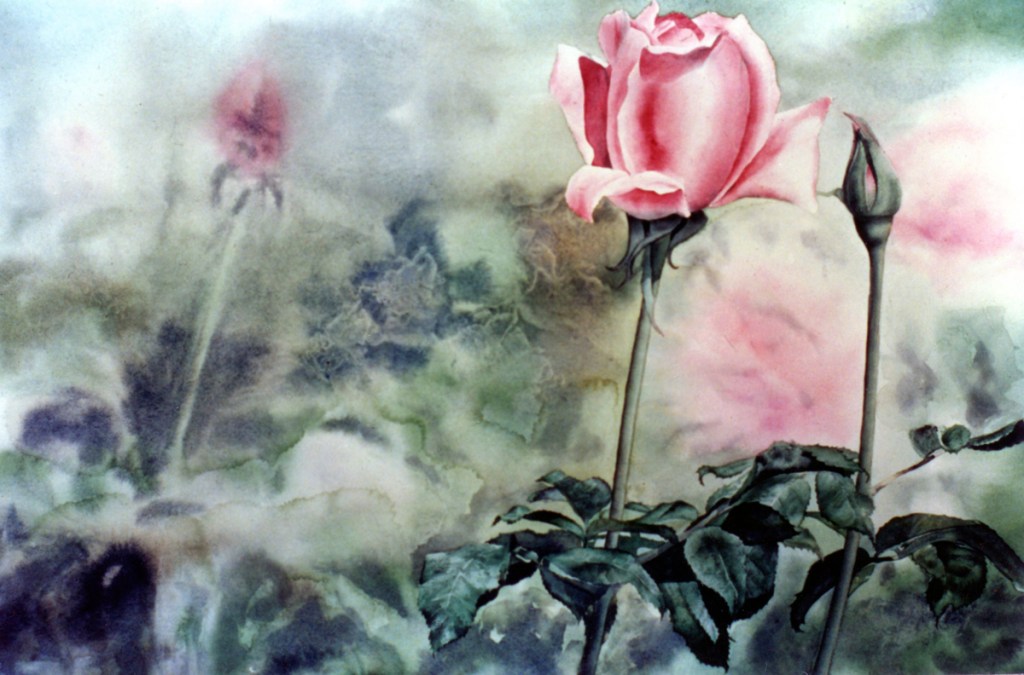
“Afternoon in Queen Elizabeth Park” Watercolor, 22″ x 30″ on Arches paper. In private collection.
A watercolor from my past, long since sold and gone. But, the time of this painting remains with me. The scene and its beauty enticed me to take it in, and share it. It was long before my pursuing a formal fine arts education, which I deemed out of my reach at the time. Like so many others, I painted what appealed to me and what I found aesthetically pleasing–sold my work at local galleries and taught some watercolor courses at the nearby art center.
I had to scan an old 35mm analog source to get access to what I had left of this painting and that should help date the piece? I haven’t done watercolors for some time now but this brings back a lot of good memories for me, realizing the time that’s passed since then.
I couldn’t help including this old favorite of mine, although it’s a long time since I painted it but it triggers a lot of memories for me.
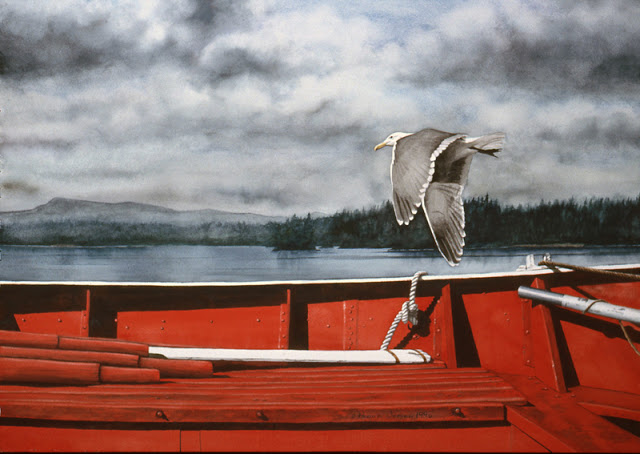
I was on the ferry to visit a dear friend, who has long since passed away. While out on deck to enjoy the scenery, I noticed how the sun empowered those potently red interiors of the lifeboats, all in perfect contrast to an otherwise subdued and clouded Pacific West Coast sky. In my eyes, it just had to be painted and although it came with some difficulties–I quite like the result.
While a watercolor of this type wouldn’t hold much appeal in a western European market, it went very quickly in North America and sold appropriately to a hotel in Victoria, British Columbia–where many of their customers might have easily recognized the beautiful lifeboats when ferrying to any of the Gulf Islands or Victoria.
Time has since passed, and after being contacted by the new owner, I can confirm this painting to be in a private collection.


 Baagøe Jepsen